

When a single study schedule contains a short foreign-language word, a formula, a code sample, and a large conceptual problem, treating them as equal does not work. Each card requires a different amount of time and a different kind of mental effort.
To distribute learning realistically, WitSlice evaluates every card using two independent values:
- estimatedMinutes describes how much active time a first meaningful study pass usually takes;
- contentLoad describes how much cognitive processing the target learner must perform.
The distinction matters. A long card can be easy, such as a ten-minute recording about a familiar topic. A short formula, on the other hand, may require substantial understanding and several prerequisites.
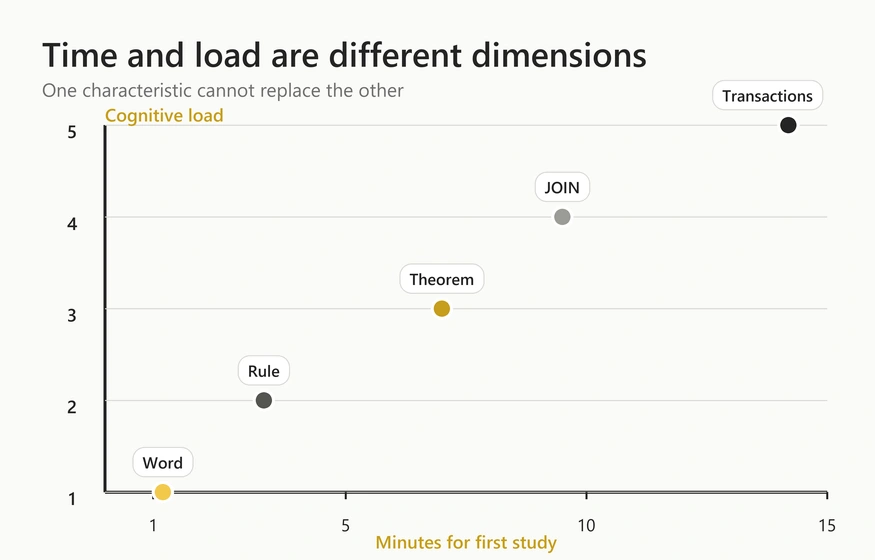
Why WitSlice evaluates cards
The evaluation is not a grade assigned for its own sake. It helps align card content with the learner's actual capacity.
WitSlice can use the two values to:
- avoid sending a demanding card during a short free moment;
- combine shorter and longer activities within one study session;
- prevent overload even when the card-count limit has not been reached;
- distribute material from several packs;
- choose an appropriate time for first study and later review;
- show the learner a realistic session duration.
A card-count limit alone is not enough. Six vocabulary terms and six multi-step problems create very different workloads. A useful schedule therefore considers card count, expected duration, and cognitive load together.
What estimatedMinutes means
estimatedMinutes is a whole number from 1 to 15. It represents the active time a typical member of the target audience needs for the first meaningful study pass.The estimate includes:
- reading, viewing, or listening to the material;
- understanding its main idea;
- completing the included knowledge check;
- reading the answer or feedback.
Notification delay, distractions, and time when the card was simply left open are excluded. Later reviews are also treated separately: recalling familiar material is usually faster than learning it for the first time.
How study time is calculated
The evaluator breaks the card into four parts:
Study time = consumption + comprehension + task + feedbackFor example, a card about the Pythagorean theorem may need one minute for the explanation, one minute for the diagram, two minutes for a worked example, two minutes for an independent problem, and one minute for feedback. Its final estimate is 7 minutes.
Four practical bands are used for planning:
- 1–2 minutes — a micro-card containing a word, term, or short fact;
- 3–5 minutes — a brief explanation with one check;
- 6–10 minutes — focused study with an example and application;
- 11–15 minutes — deep study based on a scenario or multi-step task.
If the first pass takes more than 15 minutes, the material should usually become a sequence of cards or a separate lesson.
What contentLoad means
contentLoad is scored from 1 to 5. It reflects the mental processing required from a particular target audience, not the amount of text on the screen.Before scoring a card, the evaluator identifies:
- the target audience;
- one primary learning objective;
- knowledge assumed to be familiar;
- the expected action: recall, explain, apply, analyze, or solve.
The same card can produce different loads. A formula may be a level 1 or 2 reminder for a specialist and new level 4 material for a beginner.
Five load factors
The evaluator considers five factors. Each receives 0, 1, or 2 points.
New elements. A single fact creates little working-memory demand. Several new concepts that can be tested independently increase the load.
Relationships. Direct recall is easier than comparison. A system of interdependent relationships requires more processing.
Abstraction. A concrete example is easier than a rule or model. A symbolic or counterintuitive idea is harder than a model supported by a familiar example.
Operations. Recognizing the correct answer is easier than applying a rule. Multi-step analysis, derivation, and diagnosis belong to higher load levels.
Prerequisites. Material based on general knowledge is easier than a card that requires the learner to hold several specialized concepts in mind.
The total becomes the contentLoad: minimal processing corresponds to level 1, while integration of a complex system corresponds to level 5.
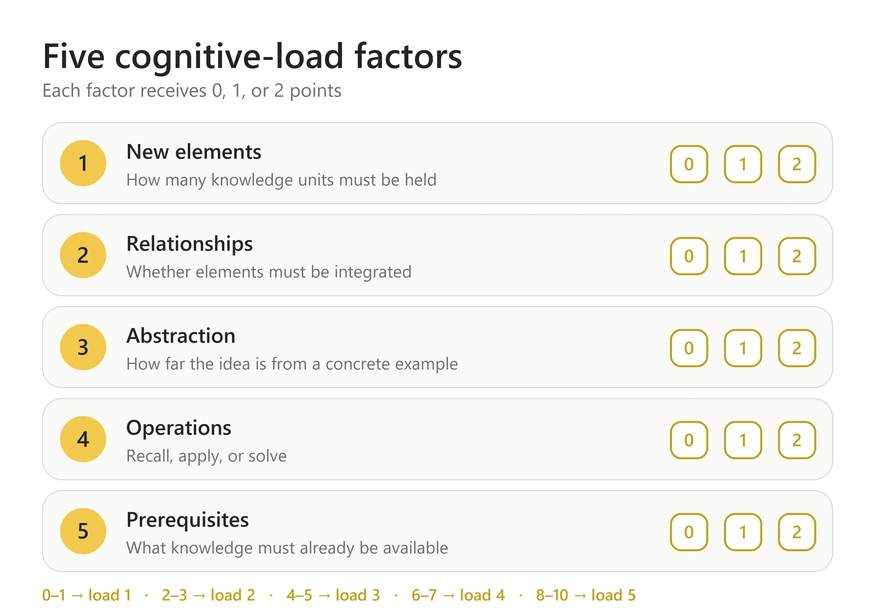
What the load levels look like
Level 1: recall
One term, fact, word, or notation. The learner only needs to recognize or retrieve the answer.
Example: an English word, its translation, and a short phrase.
Level 2: explain or distinguish
One concept and one simple relationship. The learner explains a difference or selects the appropriate option.
Example: the distinction between its and it’s, supported by two sentences.
Level 3: apply
Several related elements and one clear procedure. The learner applies a rule to a new example.
Example: the Pythagorean theorem with a diagram and one problem.
Level 4: analyze
A model, comparison, or multi-step procedure. The learner needs established prerequisites and an independent solution.
Example: comparing INNER JOIN and LEFT JOIN by analyzing query results.
Level 5: diagnose and justify
Several interdependent conditions or models. The learner must infer a cause, select a solution, or justify a decision.
Example: choosing an isolation level for a concurrent-transaction scenario.
Level 5 is intentionally rare. A card at this level belongs in allocated study time, not in a random break between other activities.
Difficulty should not come from poor presentation
Confusing prose, a missing explanation, unreadable media, and unnecessary detail do not deepen a learning objective. They create avoidable load.
WitSlice treats these cases as content defects to repair. A card must not receive a high contentLoad simply because it is difficult to read.
Every card also keeps one primary learning objective. High load should come from depth and integration, not from combining unrelated topics.
How the estimates participate in learning
First, the card receives an initial time and load estimate. The scheduler can then match it with the learner's available windows and the rest of the due queue.
Short, low-load cards work well in flexible mode: they can be reviewed during a commute or a break. Demanding cards are reserved for focused sessions. When a session already contains a deep task, less new material is placed beside it.
Due reviews take priority over new cards. If review workload accumulates, the intake of new material can be reduced. This prevents today's new cards from turning into an unmanageable review queue several days later.
After interaction, the system receives additional signals: whether the answer was correct, whether a hint was needed, and how much active time the task required. These signals help refine later scheduling.
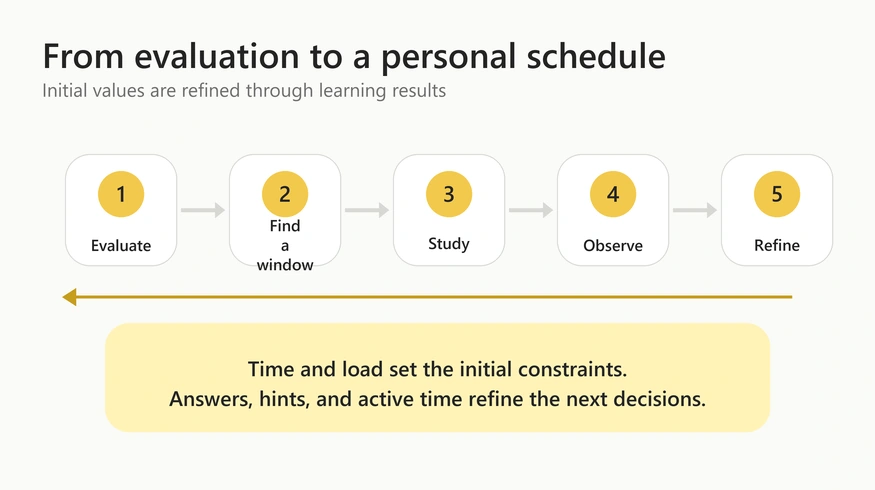
Content load is not personal difficulty
contentLoad describes a card relative to a stated audience. A particular learner can still find the same card easier or harder.The shared content score therefore does not replace personal learning history. Errors, response time, and repeated attempts contribute to individual difficulty. That personal value can affect review intervals without turning a well-written card into universally high-load content.
How the initial estimate is refined
Before publication, an author or automated evaluator estimates the time. Once enough completed sessions exist, the initial value can be compared with actual data.
Calibration uses active study only: from engaging with the material to submitting an answer, with long idle periods excluded. If most learners consistently spend substantially more or less time, estimatedMinutes can be adjusted.
contentLoad changes only when the material, audience, or required prerequisites change. One learner's results belong to that learner's personal model.Designing a card for a target level
Authors can work from constraints toward content:
- Define the audience and one learning objective.
- Choose the required action: recall, apply, or analyze.
- Limit the number of independently testable new elements.
- Reserve time for an active check and feedback.
- Verify the prerequisites.
- Score the finished card again.
A card should never be padded merely to fill a time band. If the objective is achieved sooner, the card simply receives a lower estimatedMinutes value.
The key idea
Study time and cognitive load answer different questions. The first tells the scheduler how much room a card needs. The second tells it how suitable the moment must be for focused learning.
Together, they help WitSlice build realistic sessions: short material fits into free moments, demanding material receives enough attention, and new cards do not displace necessary reviews.
Frequently asked questions about card evaluation
Word count affects reading time but not depth of processing. A short formula can be more demanding than a long text about a familiar subject.
It should become a sequence of cards with separate learning objectives or move into a full lesson format.
Study time can be calibrated from completed sessions. Content load is reconsidered when the content, audience, or prerequisites change.